
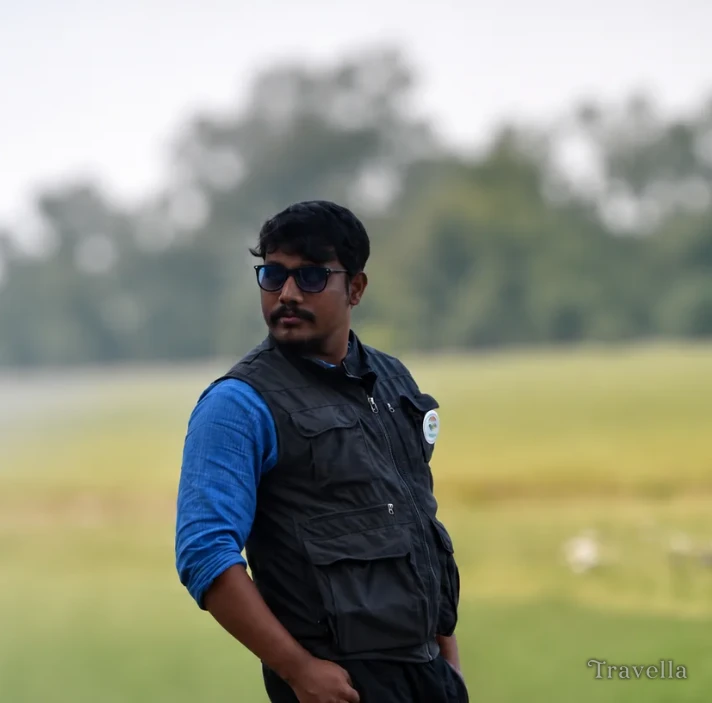
This guide is for anyone planning their first Kaziranga jeep safari. In plain words, I’ll walk you through the five big animals people hope to see, the rare ones worth dreaming about, which safari range to pick, the best time to go and how to stay safe. It’s what I tell my own guests, after six years of guiding jeep safaris in this park.
Your first Kaziranga safari, in 30 seconds. What you’ll see: rhinos, elephants, wild buffalo, swamp deer and, if you’re lucky, a tiger. Best range for a first trip: Kohora (Central), the all-rounder. When to go: October to May; December–February for cool days and birds. How long: about 2–3 hours per jeep safari; mornings are coolest and most active. Who it suits: families and small groups, up to 6 guests per jeep, priced per jeep. Included with Travella: licensed naturalist, park entry and permits, pickup and drop within 10 km.
A little about me
A safari is only as good as the person driving it. The same patch of grass can look empty to you and full of life to someone who knows where to look. Helping you see it is my job.
I grew up around Kaziranga, and the park runs in my family. My father has spent more than 30 years as an elephant mahout with the Assam Forest Department and was recently promoted to head mahout. I’ve guided jeep safaris here for six years.
I met JuBin, Travella’s founder, while Travella was shortlisting guides and jeep operators. I joined in 2025 as co-founder and Head of Safari. Today I run our safaris and train every new Travella guide-cum-driver myself, in the wildlife and in looking after guests.
Over the years, I’ve also been charged by rhinos more than once. Each time taught me to respect an animal’s space, and that lesson is at the heart of how I train our guides. I will be sharing one of those stories further down.
The Big Five of Kaziranga, explained simply
“The Central range is mostly where you see Kaziranga’s Big Five.”
1. Greater one-horned rhino: the star of the show. This is the animal that made Kaziranga famous. The 2022 census counted 2,613 rhinos here, the largest population anywhere and nearly two-thirds of all greater one-horned rhinos on Earth. You’ll often find them grazing in open grass or cooling off in muddy pools. Where to look: every range; Bagori and Kohora are the most reliable. Your chances: the likeliest of the five.
2. Asian elephant: the gentle giants. About 1,196 elephants live in Kaziranga and its additions, according to the Assam Forest Department’s 2024 estimate. Herds move between grassland, woodland and the rivers, and seeing a calf stay close to its mother is a moment most guests never forget. Elephants also help protect the park: forest staff work alongside trained elephants, and my father is one of their mahouts. Where to look: grassland, woodland edges and riversides. Your chances: good; calves are a common sight.
3. Wild water buffalo: bigger than you expect. Kaziranga has the largest population of wild water buffalo in the world. Picture the buffalo you’ve seen in a village, then make it huge, with horns that sweep out wide. This is its wild ancestor. Kaziranga’s herd is even helping the species come back elsewhere: in October 2026, eight buffaloes from here were moved to Kanha Tiger Reserve in Madhya Pradesh, about a century after the species vanished there. Where to look: wetlands and Bagori’s open grassland. Your chances: good around wetlands.
4. Eastern swamp deer: a survivor. The eastern swamp deer, a kind of barasingha, has disappeared from most of the places it once lived. Kaziranga is one of its last strongholds, so every herd you see here is special. The stags carry antlers with many points. Where to look: damp grassland near water. Your chances: herds feed in the open.
5. Royal Bengal tiger: the one everyone hopes for. Kaziranga is one of the best places on Earth for tigers. The Status of Tigers in Kaziranga 2024 report counted 148 adult tigers: 18.65 tigers per 100 km², the third-highest density in the world. But the elephant grass is taller than a person, so tigers are hard to spot. That’s what makes a sighting feel earned. A guide who listens for alarm calls and reads fresh pugmarks gives you the best chance. Your chances: rare; you’ll need a little luck.
The rare ones worth dreaming about
“There are a lot of rare sightings here.”
The golden tiger. Kaziranga is one of the very few places where golden tigers have been photographed in the wild. They are Royal Bengal tigers with a pale golden coat, caused by a rare gene. Park officials believe only about four tigers carry this colouring. One was seen in the Kohora range during the 2025–26 season.
This season (2026–27) has started well too. On 25 October we watched a tiger mother and her cub cross the track.
The white hog deer. Hog deer are common in Kaziranga, but a white (albino) one is very rare. One was photographed in the Burapahar range in 2021, and another was reported in May 2026.
Birds, birds and more birds. Even if you’ve never thought of yourself as a bird person, Kaziranga might change that. More than 490 bird species have been recorded here. In winter the wetlands fill with visitors from far away: the January 2026 waterbird count found 1,05,540 birds of 107 species, led by bar-headed geese and northern pintails.
“With all the migratory birds, the nature here is beautiful.”
For birding, the Agoratoli (Eastern) range is a favourite.
Which safari range should you choose?
Kaziranga is split into four main tourist ranges, and each one feels different. Travella runs jeep safaris in all four. The simplest way to choose is to start with what you most want to see.
Kohora (Central): a bit of everything, on your first trip. The main tourist hub, with rhino, elephant, buffalo, swamp deer and recent golden tiger sightings.
Bagori (Western): the best chance of rhinos and wild buffalo. Wide open grassland, about 12 km west of Kohora.
Agoratoli (Eastern): birds and quiet tracks. Wetlands and winter birdlife, near Bokakhat. Also spelled Agaratoli.
Burapahar (Ghorakati): forest, hills and something different. Low hills and forest, hoolock gibbons, and gharials seen in 2025–26. About 25 km west of Bagori.
Still not sure? Tell us what you most want to see, and my team and I will suggest a range. Booking two ranges lets you see both the grassland and the wetland sides of the park.
When to go, and safari timings
The Kaziranga season runs from October to May. For 2026–27, the park opened on 3 October 2026, starting with jeep safaris in the Kohora range.
October–November: the season begins, and the grassland is green and tall. December–February: cool, dry days and the peak of the winter bird season. March–May: the grass is burnt back, so open views get easier, but days get hot.
Timings: at the start of the season, jeep safari entry slots were 7:30–10:00 am and 1:30–3:00 pm. A Travella jeep safari lasts about two to three hours. If you can only do one, go in the morning: the park is at its coolest and most active.
What’s included: a licensed naturalist guide, park entry and permits, and hotel pickup and drop within 10 km of the park. Each jeep seats up to six guests and is priced per jeep, so families and small groups share the cost.
“Then it charged”: why your guide matters
Rhinos are huge, fast and protective of their space. Guests often ask me if they ever charge a jeep. Honestly, encounters happen sometimes, but not every day. Has it happened to me? Many times.
I remember one drive in the Eastern range well.
“I was driving along, and suddenly it came out right in front of us. We were completely face to face. Then it charged, so I drove us out of there.”
That calm, quick judgement only comes from years in the forest. A good guide reads an animal’s mood early and knows when to wait, when to back off and when to move. Your safety depends on it, which is why I train every new Travella guide-cum-driver myself.
How to be a good guest on safari: stay seated and keep your hands and cameras inside the jeep. Keep your voice low, especially near rhinos and elephants. Never ask your driver to get closer to an animal or to leave the track. Follow your guide’s instructions straight away.
What our guests say
I’d rather let our guests tell you about their Kaziranga mornings than tell you myself. One of them summed it up simply: “The safari at Kaziranga was exceptional.”
Why plan your safari and stay with Travella
Travella is a local team based on NH 715 in Kohora, right at Kaziranga’s main tourist hub. We’re from here, and we want you to feel Kaziranga the way we do.
Guides I train myself, in wildlife knowledge and in looking after guests. Every range covered: Kohora, Bagori, Agoratoli and Burapahar, plus Manas National Park. Stays close to the wild: handpicked stays near the park, from Villa Arborea and Jungle Cottages to the Heritage Tea Bungalow. One team, one plan: book a safari online, ask about a stay, or let us combine both into one trip.
A few mornings with our guests
Some of my favourite moments have nothing to do with animals. It’s a family holding their breath at their first rhino, kids passing binoculars around, or a quick selfie at the gate before we head in.
“Come to Kaziranga. Come and explore.” I’d love to show you my Kaziranga. Book your Kaziranga jeep safari or chat with us on WhatsApp to plan your trip.
About the author: Ekbal Ali is co-founder and Head of Safari at Travella. He grew up around Kaziranga, has guided jeep safaris in the park for six years, and trains every Travella guide-cum-driver himself.
Kaziranga safari FAQs
What are the Big Five of Kaziranga? The greater one-horned rhino, the Asian elephant, the wild water buffalo, the eastern swamp deer and the Royal Bengal tiger.
Which Kaziranga range is best for rhinos? Rhinos live in every range. The Bagori (Western) and Kohora (Central) ranges have wide open grassland where they’re easiest to see.
Can you see a tiger on a Kaziranga jeep safari? Yes, but tigers are rare and seeing one needs luck. Kaziranga has 148 adult tigers and one of the highest tiger densities in the world, but tall grass hides them well.
What are the Kaziranga jeep safari timings? At the start of the 2026–27 season, entry slots were 7:30–10:00 am and 1:30–3:00 pm. A Travella safari lasts about two to three hours. Check current slots when you book.
When is the best time to visit Kaziranga? The season runs from October to May. December to February is cool and best for birds. March to May brings more open views.
Which range should I choose for my first safari? Kohora (Central). It’s the main tourist hub and the best all-rounder for the Big Five.
How many people can go in one safari jeep? Up to six guests per jeep. Travella prices jeep safaris per jeep, not per person.
What’s included in a Travella jeep safari? A licensed naturalist guide, park entry and permits, and hotel pickup and drop within 10 km of the park.
Where should I stay for a Kaziranga safari? Staying near Kohora puts you close to the Central range and the main gate. Browse Travella’s Kaziranga stays to find one that suits you.
Who is Ekbal Ali? Ekbal Ali is the co-founder and Head of Safari at Travella. He grew up around Kaziranga, has guided jeep safaris for six years, and trains new Travella guide-cum-drivers.
A little of what’s here.
- Licensed naturalist guide
- Park entry and permits
- Hotel pickup and drop within 10 km
- Up to 6 guests per jeep
- Priced per jeep
- Safaris in Kohora, Bagori, Agoratoli and Burapahar